

Precision forest inventory, down to the individual tree
Know exactly what species are in your forest. Using our proprietary deep learning tool detectree2, we transform aerial and drone imagery into inventory-grade maps without the time or cost of a full ground survey.
-
Back carbon stock estimates with tree-level data, not plot-based extrapolation.
-
Show species-level evidence for habitat protection and funding cases.
-
Verify what's actually standing before pricing or underwriting the asset.
Built for the people safeguarding forest inventory.
Accurate species inventory is the foundation of credible carbon accounting and conservation decisions.
Carbon stock estimates, biodiversity claims, and conservation budgets are too often built on sparse ground plots extrapolated across an entire concession. That gap is easy to overlook, until a registry, investor, or auditor asks for evidence.
Precision inventory closes that gap. Knowing exactly what's standing — every crown, every species — is the foundation for credible carbon accounting, defensible biodiversity claims, and conservation decisions that target the areas that actually need it.
What we offer:
We combine high-resolution UAV imagery, hyperspectral data, and deep learning to map forests at the level of the individual tree — not the plot, not the hectare.
Species-level classification


Outputs that ground your claims
Change detection over time


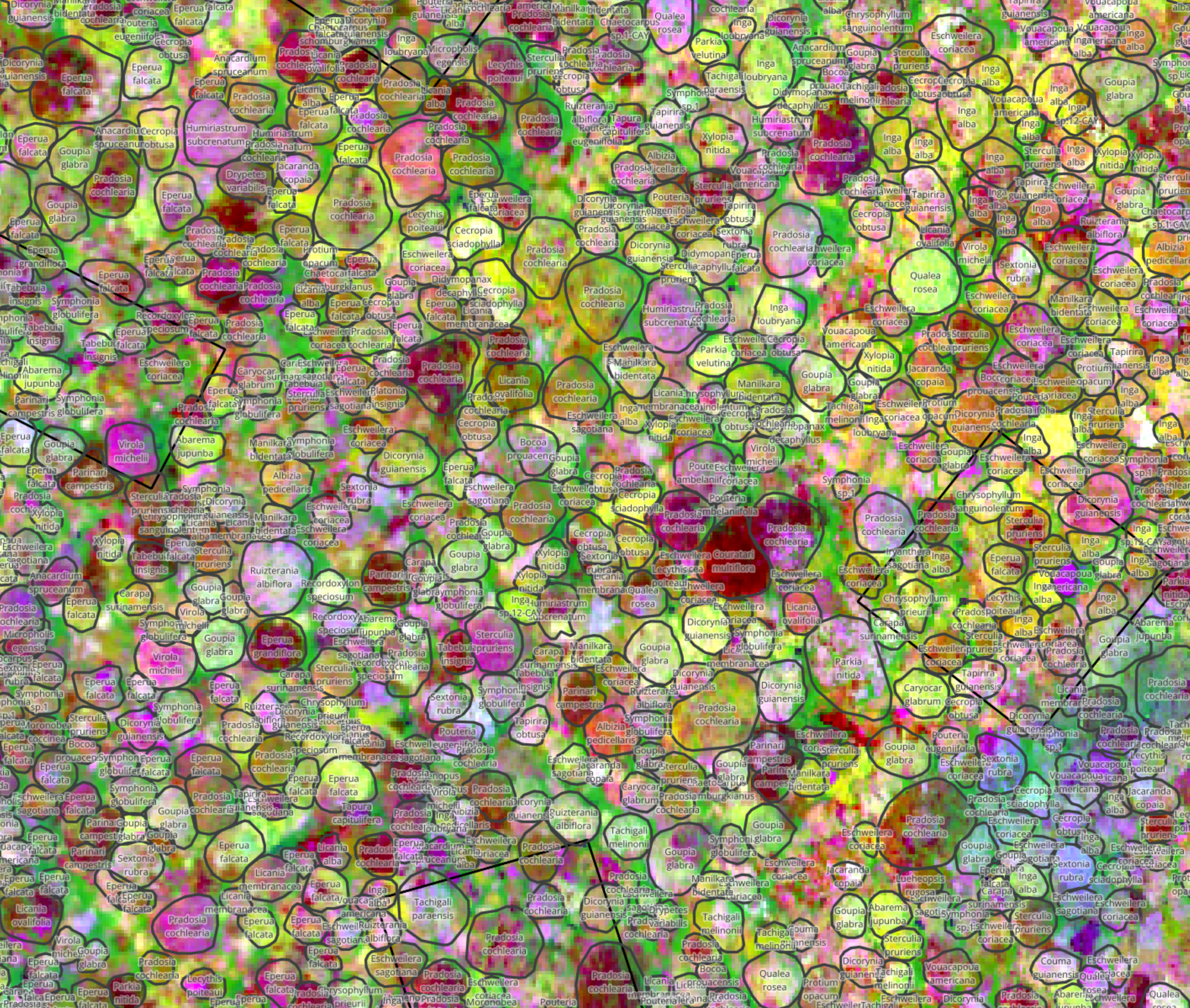
We classify tree species from RGB, multispectral, and hyperspectral imagery, reaching up to 75% species accuracy in complex tropical forests.
Individual tree crown delineation
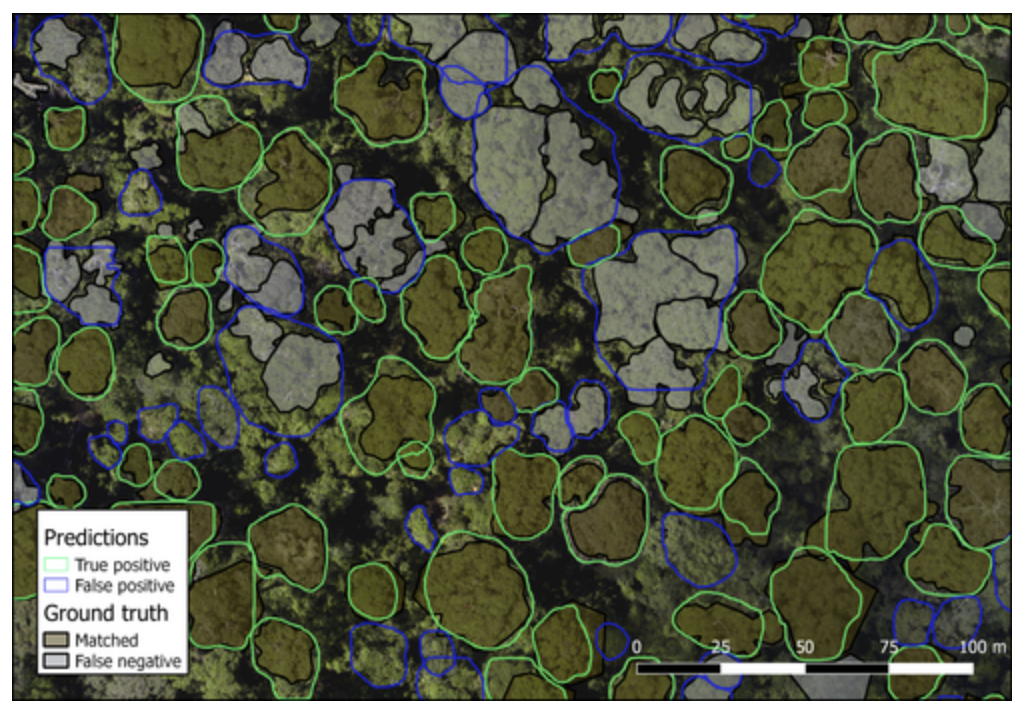
We detect and outline single tree crowns from aerial, drone, and satellite imagery using detectree2, our open-source Mask R-CNN system - achieving up to 74% delineation accuracy for the tallest trees,
Species composition maps, crown-dimension data, and canopy-structure assessments - formatted to support carbon MRV, biodiversity credits, and EUDR documentation.
Multi-temporal stacking lets us track growth, mortality, and health shifts tree by tree, improving accuracy by around 9% over single-date analysis and surfacing changes traditional methods miss.
Spicy Forest Stats
Explore interactive visualizations that uncover insights, reveal trends, and help guide smart decisions. Our charts and graphs turn numbers into narratives—helping you understand and explore key information at a glance.
Case Study
Mapping an island's trees to protect its future
To aid their conservation efforts, the Faya Foundation tasked us with developing a comprehensive tree map of Principe Island, a UNESCO Biosphere Reserve off the coast of West Africa with forest that is dense, tropical, and highly biodiverse.
Faya Foundation
Related Research
“Accurate delineation of individual tree crowns in tropical forests from aerial RGB imagery using Mask R‐CNN”
Pair species-level maps with the tools to act
Knowing exactly what's standing today is only half the picture.
Explore Risk Intelligence to forecast where deforestation is likely to threaten it next.
Explore Sensor Strategy to see how we design the UAV and hyperspectral data collection that makes precision inventory possible in the first place.
Let’s discuss your forest.
Reach out to find out more about how forestmap.ai can help your organization.
info@forestmap.ai
+44 (0)7986 882 740
By submitting this form, you acknowledge our Privacy Policy.
