
End-to-end sensor strategy tailored to your project
Build a monitoring pipeline you can rely on. We design end-to-end sensing strategies that match sensor, resolution, and collection method to the specific question your monitoring programme needs to answer.
Most forest monitoring programmes are built around the data that's available, not the data that's needed.
Sensors get chosen based on availability or cost rather than fit. Collection schedules get set without accounting for cloud cover, canopy density, or site access. Multi-sensor data arrives from the field with no clear integration plan. By the time the mismatch surfaces, collection budgets are spent and the outputs don't support the decisions they were supposed to.
Match your sensor to your question
We assess your monitoring question, your site, and your operational constraints before recommending a sensor combination, to ensure what’s collected is what the analysis actually needs.
We work across seven sensor modalities, from broad-coverage satellite to fine-scale hyperspectral UAV.
Everything we deliver is analysis-ready, fully documented, and immediately usable by your team.
Get analysis-ready outputs, not raw files
We run the full processing pipeline, from raw imagery through to mapped, calibrated, analysis-ready outputs. Every deliverable is documented, reproducible, and ready for direct integration into a monitoring system or third-party review.
Extend your reach with geospatial foundation models
Where labelled training data is sparse — such as a new site, an under-mapped region, or a data-poor species assemblage — we apply geospatial foundation models to extend mapping coverage and reduce ground-truth data requirements without sacrificing accuracy.
Our CEO's active research in geospatial foundation models is directly integrated into our sensor strategy work.
[Read the research →]
How we work
Sensor design


Processing and integration
Data collection


We select and configure the sensor combination that fits your question and your environment, drawing on experience across satellite, UAV, LiDAR, multispectral, and hyperspectral platforms across tropical Asia, Africa, and Latin America.
Scoping
We define the monitoring question, the required spatial and temporal resolution, and the operational constraints of your site — cloud cover, access, canopy density — before any sensor is selected.
We run the full processing stack, fusing multi-sensor inputs into coherent, calibrated outputs — species maps, canopy structure models, risk layers — ready for analysis or direct integration into a monitoring system.
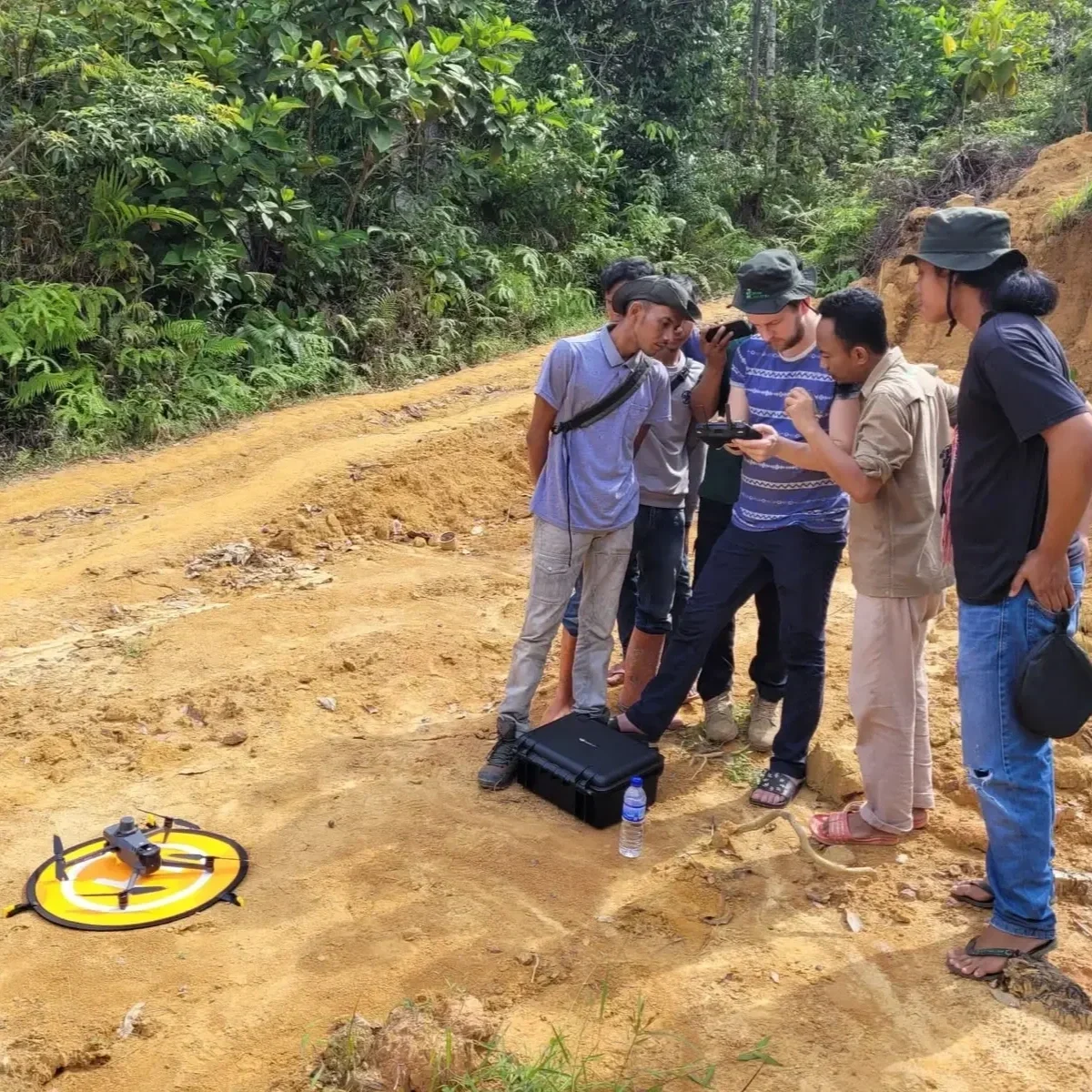
We manage or oversee field collection — UAV flights, ground-truth campaigns, sensor calibration — ensuring what comes back from the field is what the processing pipeline needs.
-
We scope the full sensing strategy from the start, so sensor selection, collection design, and processing pipeline are aligned before any budget is committed to the field.
-
We diagnose the mismatch, identify what's missing, and redesign the collection and processing approach around what the decision actually needs.
-
We assess whether it fits your site and question, and design an alternative if it doesn't — accounting for the operational realities of your specific environment.
Who we work with.
Case Study
Mapping an island's trees to protect its future
To aid their conservation efforts, the Faya Foundation tasked us with developing a comprehensive tree map of Principe Island, a UNESCO Biosphere Reserve off the coast of West Africa with forest that is dense, tropical, and highly biodiverse.
Faya Foundation
Related Research
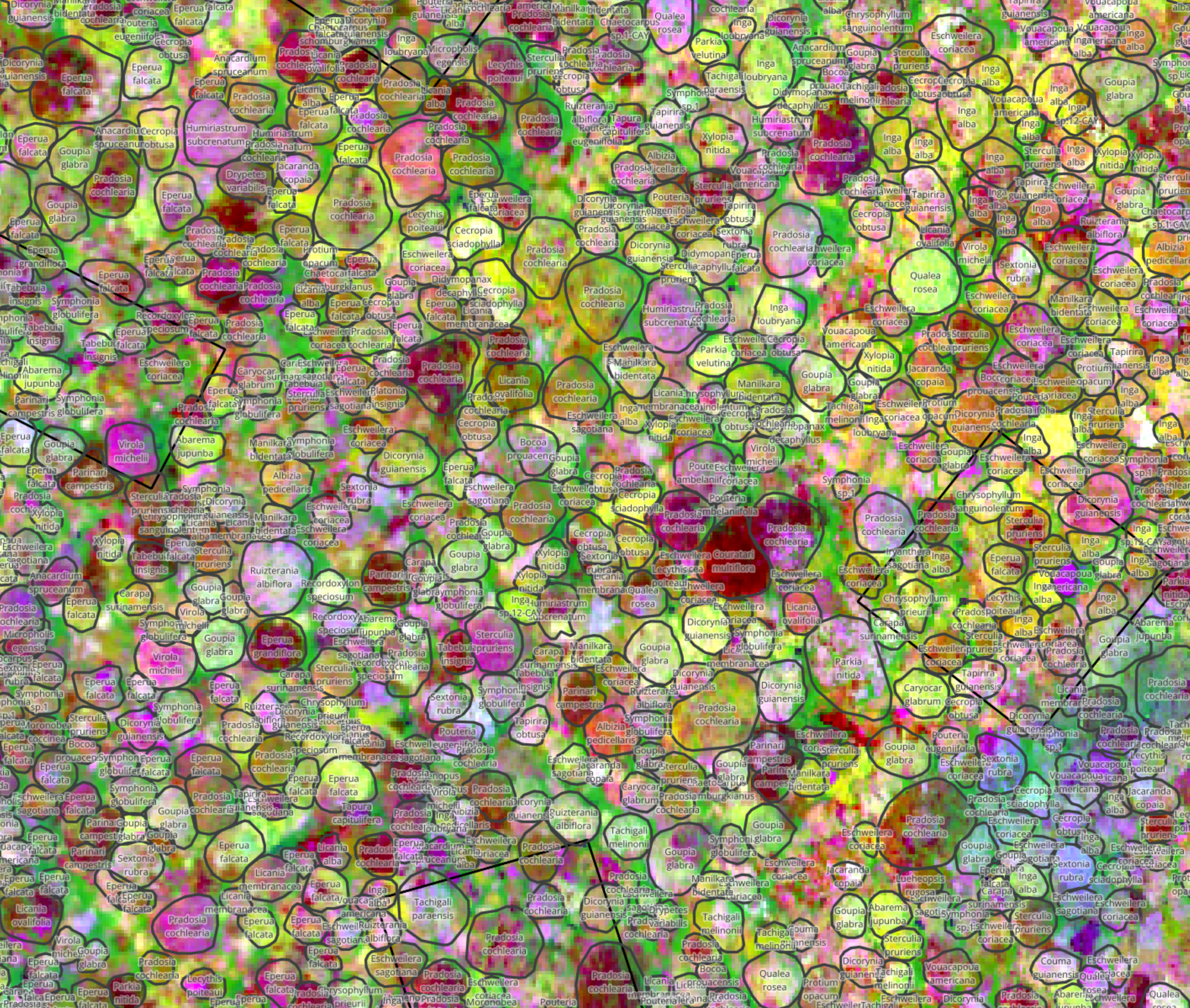
“Harnessing temporal and spectral dimensionality to map and identify species of individual trees in diverse tropical forests.”
bioRxiv
9(5), 641-655
Ball, J. G. C., et al.
Pair sensor strategy with what the data builds
A strong sensing strategy is just the foundation.
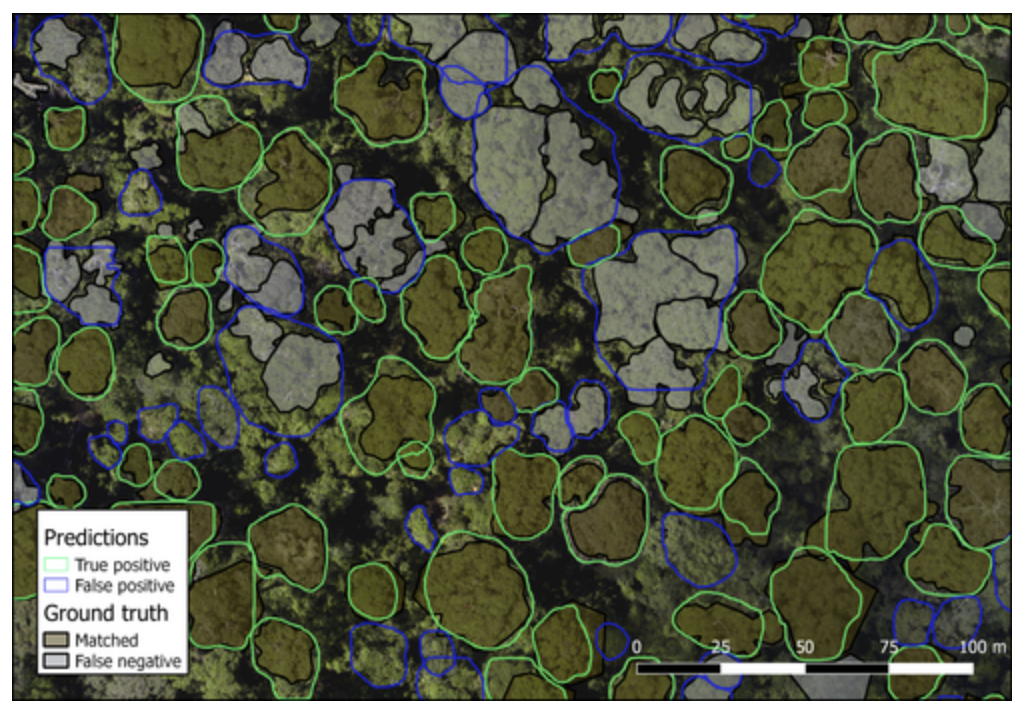
Explore Precision Inventory → to see how UAV and hyperspectral outputs feed directly into species mapping and crown delineation.
Explore Decision Support → to see how we build the audit-grade monitoring systems that run on top of the data we collect.
Let’s discuss your forest.
Reach out to find out more about how forestmap.ai can help your organization.
info@forestmap.ai
+44 (0)7986 882 740
By submitting this form, you acknowledge our Privacy Policy.
